




When Medical Imaging Hits the Road
In the late 1970s, healthcare became part of the company’s activities with the development of its first mobile medical units, particularly for occupational health. The principle was simple: to enable medical teams to monitor employees directly at their workplace.
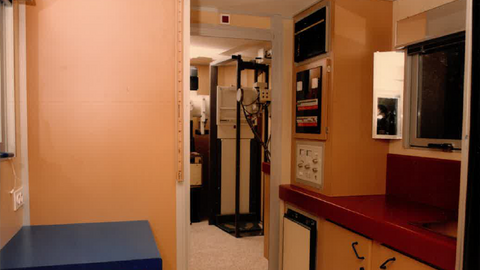
In the 1980s, a new milestone was reached with the integration of chest radiography into occupational health vehicles, particularly for tuberculosis screening.
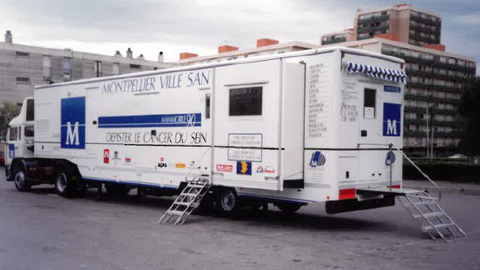
At the beginning of the 1990s, mammography further expanded the scope of mobile medical imaging, bringing breast cancer screening closer to women wherever they live.
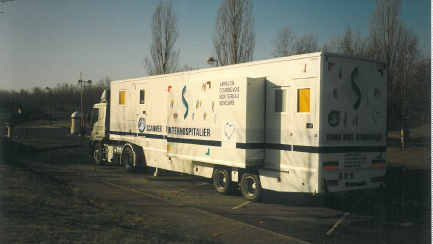
Still in the 1990s, mobile imaging moved to a new scale with CT scanning.
This new application notably paved the way for sharing major medical equipment between hospitals: rather than installing multiple fixed systems, the CT scanner could move from one site to another as needed.
Radiography, mammography, CT scanning: within the space of a decade, medical imaging gradually became an established part of Toutenkamion’s mobile solutions.
The Growth of Mobile Medical Imaging
In the 2000s, mobile medical imaging gained momentum. The number of projects increased, both in France and internationally, with mobile units produced both individually and in series.
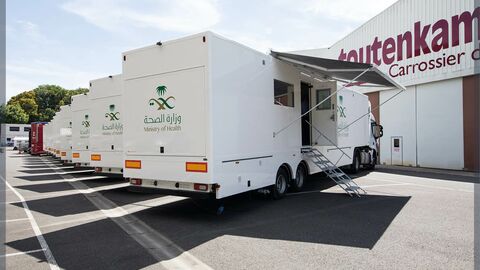
As part of large-scale programmes, notable examples include the delivery of 10 mobile mammography units to the Saudi Ministry of Health in 2020, 15 mobile clinics integrating mammography and ultrasound in Burkina Faso in 2024, and 40 mobile clinics for Pakistan over several years, dedicated to women’s and men’s health.
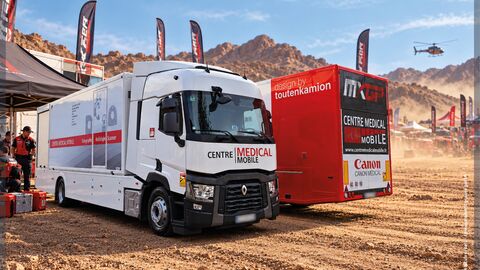
While screening remains at the heart of mobile applications, mobile imaging also meets diagnostic needs.
The Mobile Medical Centre illustrates another application, with the deployment of medical trucks at sporting events such as the Dakar Rally, providing imaging facilities directly on site.
In total, more than one hundred mobile medical imaging units have already been delivered worldwide.
This growth also brings another requirement: the ability to operate in a wide range of environments.
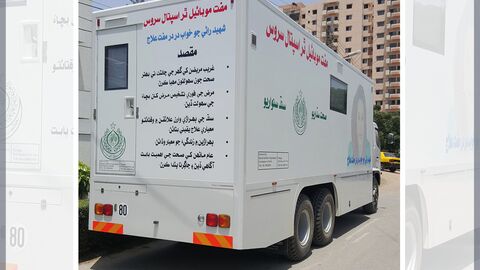
Local regulations and radiation protection requirements, operating conditions and equipment specifications: each mobile unit is designed according to its intended location and use.
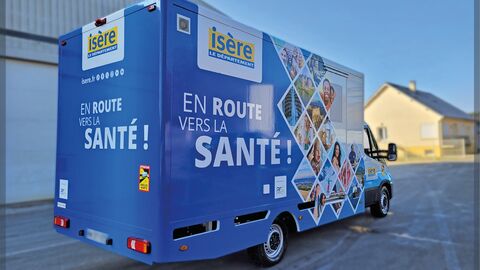
This adaptation is reflected in the size and layout of the units, depending on the equipment carried on board.
From compact vehicles to spacious mobile units, every square metre counts on board.
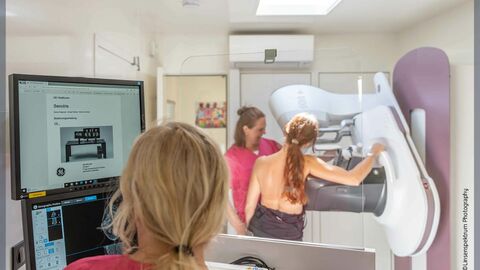
The layout of the spaces must ensure a smooth patient journey from reception and preparation through to the examination, while preserving confidentiality and providing suitable working conditions for healthcare professionals.
Ergonomics, flow and accessibility are therefore integral to the design.
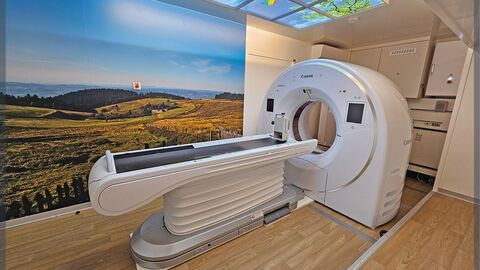
Particular attention is also paid to the interior environment.
The choice of materials, lighting, sense of space and finishes all help to make these technical spaces welcoming and create a reassuring environment for patients.
From Mobile Imaging to Connected Imaging
Advances in equipment are driving lasting changes in mobile radiology units. Conventional systems are gradually giving way to digital technology, transforming image processing, patient data management and remote transmission.
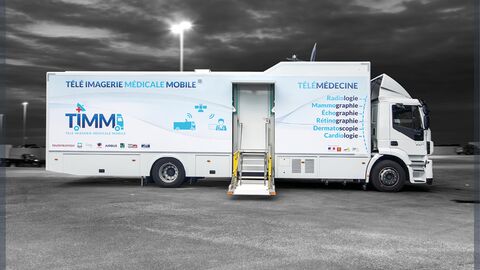
This evolution took on a new dimension with TIMM – Mobile Medical Tele-Imaging.
Developed by Toutenkamion and its partners, then implemented and tested by Lannemezan Hospital and CETIR in 2017, TIMM became the first mobile telemedicine unit connected in real time to an expert centre.
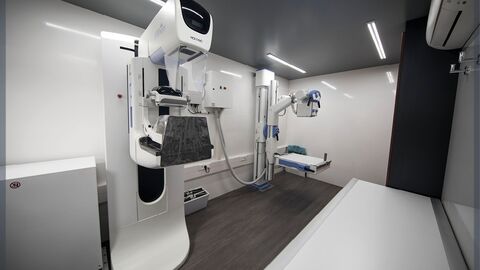
Designed as a community-based medical imaging service, the mobile unit enables a range of medical procedures to be carried out on board.
Permanently connected to medical practitioners and radiologists, it creates a direct link between patients, general practitioners and specialists.
Mobile imaging makes it possible not only to move equipment, but also to bring medical expertise closer to where the examination is carried out.
Mobile Imaging as a Complement to Fixed Facilities
Mobile medical imaging solutions complement existing services. By bringing equipment closer to communities, they can help facilitate access to screening and strengthen healthcare coverage across different regions.
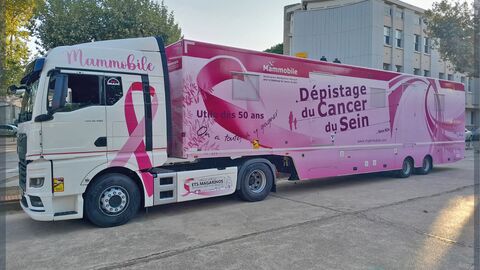
Nearly 40 years after its first tours, this Mammobile continues to reach women across the region, helping to improve access to breast cancer screening.
Since its creation, more than 600,000 screening tests(1) have been carried out on board, and today it can perform up to 13,000 mammograms per year as part of the breast cancer screening programme(2).
Early detection remains a major challenge today. Lung cancer is another example: 70% of cases are still diagnosed at an advanced stage(3).
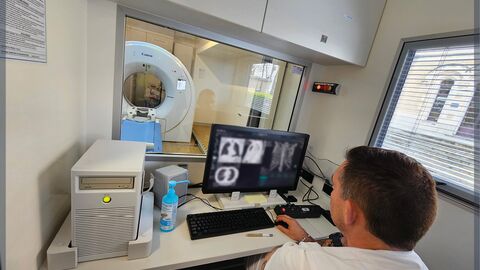
In 2025, the Hospices Civils de Lyon Pneumology Mobile Unit was equipped with a low-dose CT scanner as part of French pilot lung cancer screening program. The programme aims to reach up to 2,000 people each year through this mobile service. (3)
The mobile unit goes even further, providing a comprehensive pathway for the prevention of smoking-related diseases.
Over several decades, equipment has changed, applications have diversified and technology has opened up new possibilities. But the principle behind mobile medical imaging remains the same: adapting imaging resources to real-world conditions and bringing them closer to those who need them.
A story that continues to unfold today, evolving alongside advances in medical imaging and healthcare practices.
(1) Montpellier-Hérault Association for Breast Cancer Screening
(2) French Court of Auditors report on breast cancer prevention and care – January 2026
(3) Pneumology Department at Lyon Sud Hospital